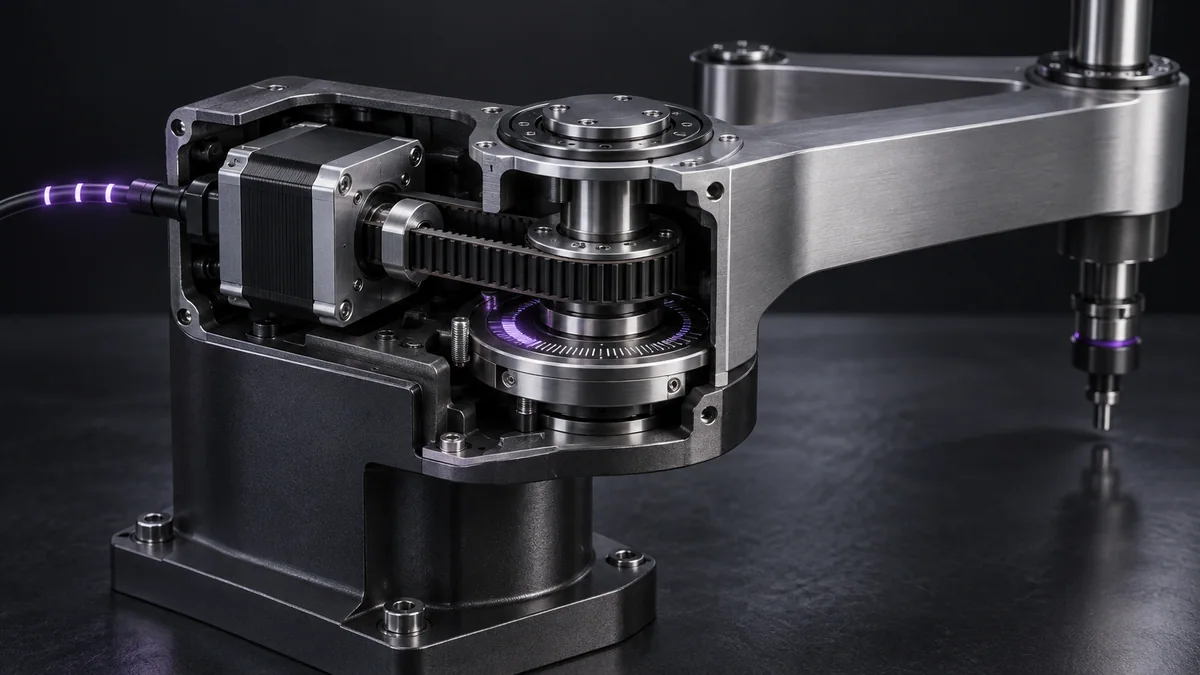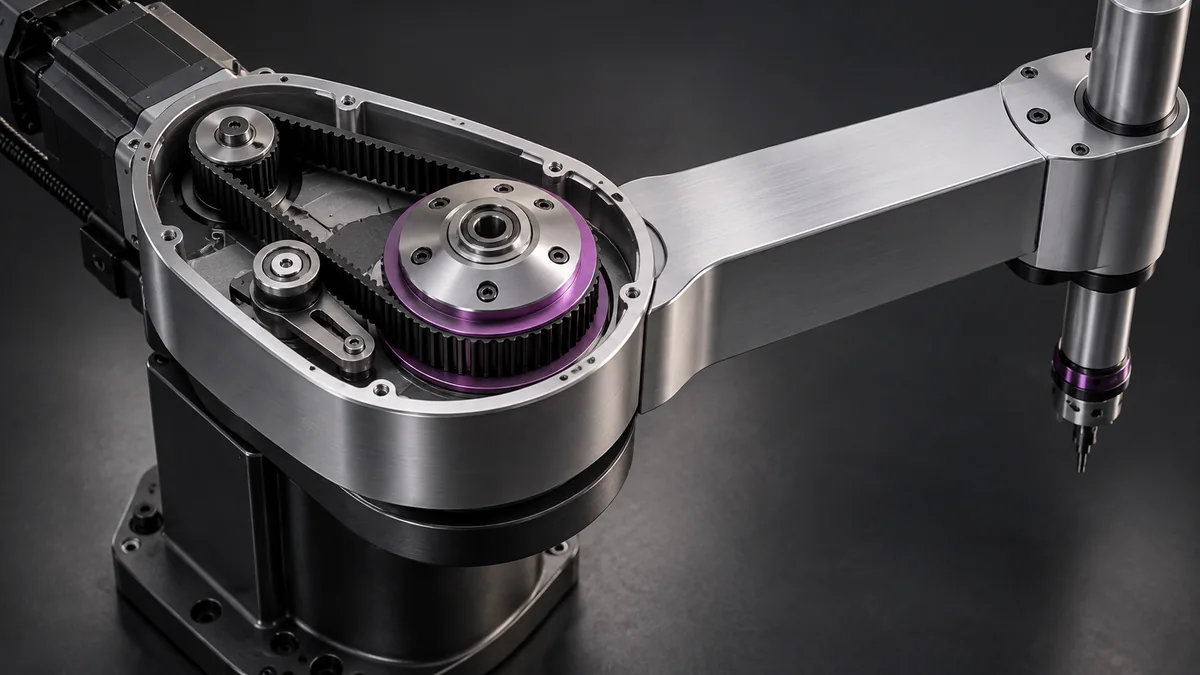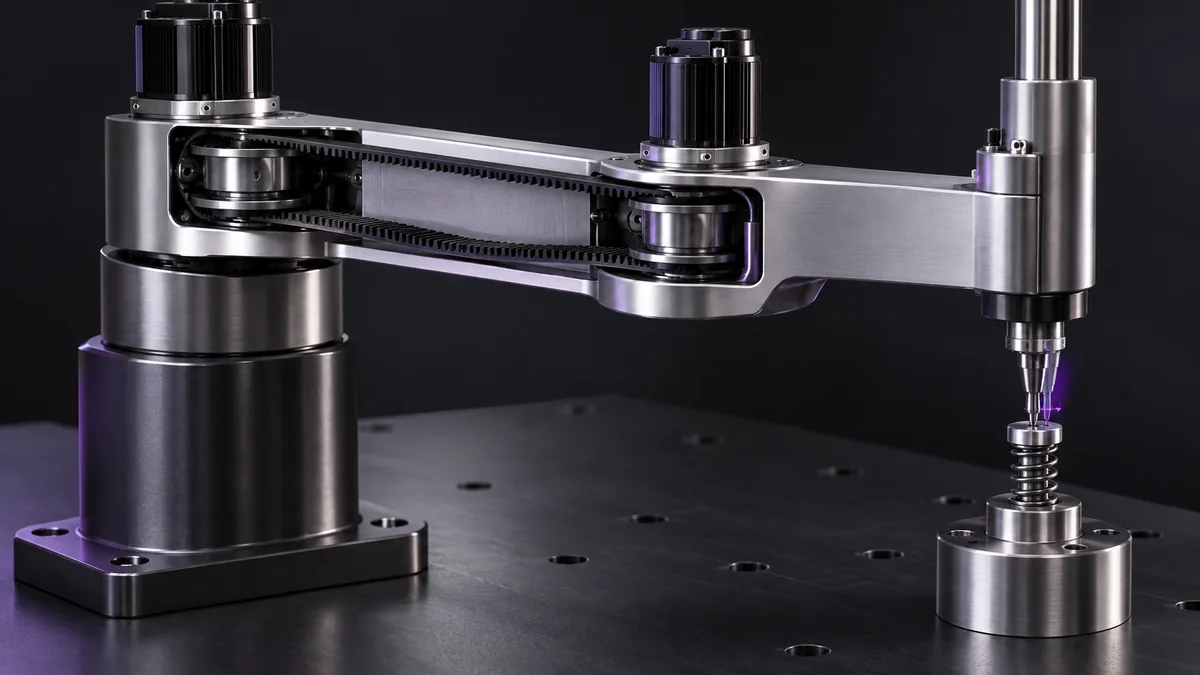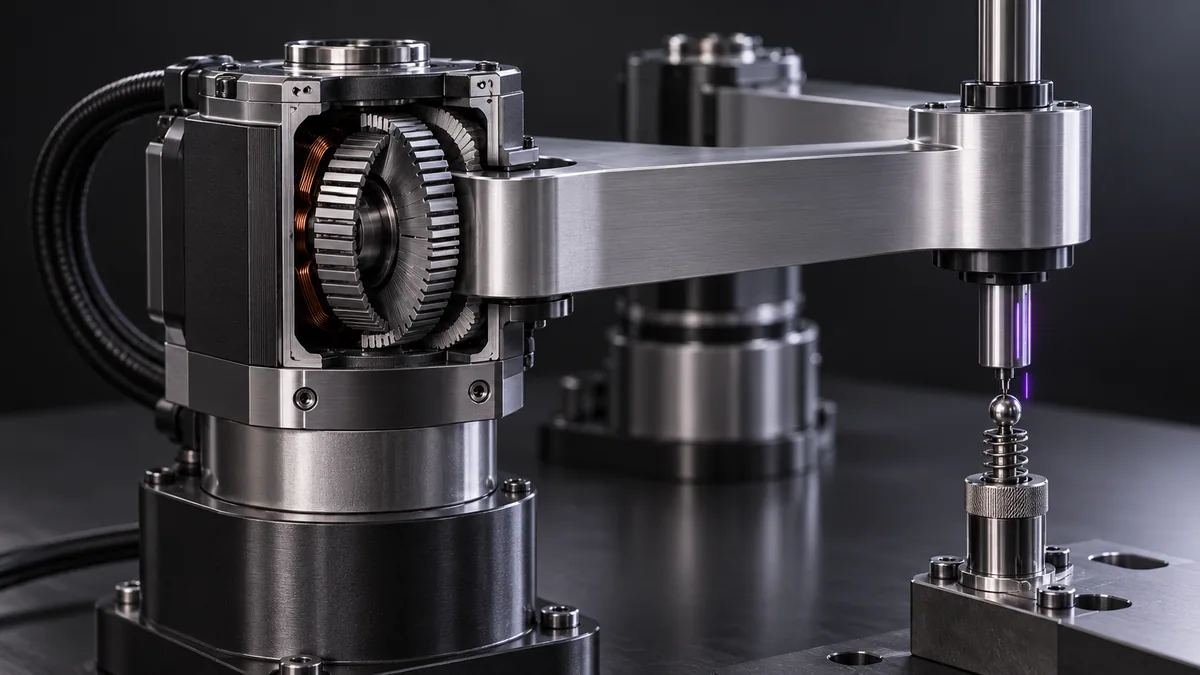
What you need
Use an offline sensitivity calculation and a guarded measurement setup for any later hardware test.
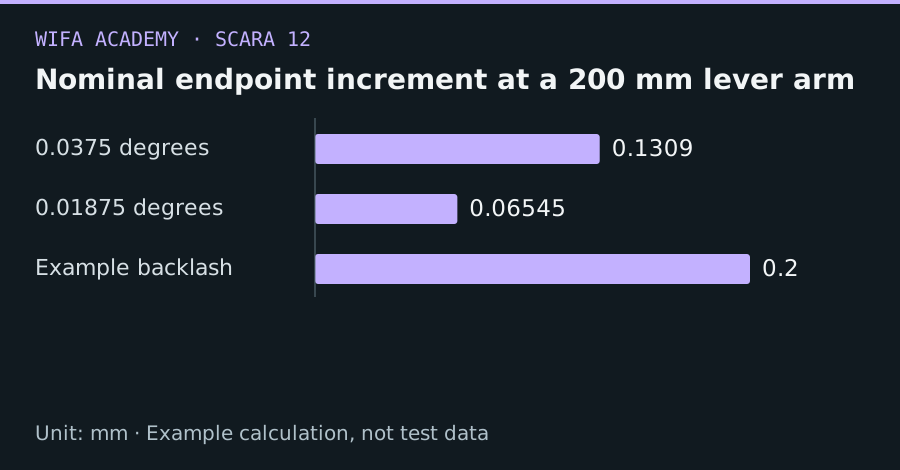
Read the diagram as a data table
| Condition or component | mm |
|---|---|
| 0.0375 degrees | 0.1309 |
| 0.01875 degrees | 0.06545 |
| Example backlash | 0.2 |
The calculation
δx_tangent ≈ r × δθ
r is the effective lever arm in mm and δθ is a small angle in radians. This estimates tangential displacement for one joint contribution.
Worked example
At a 200 mm lever arm, a nominal 0.0375° increment corresponds to 0.131 mm. Halving it to 0.01875° gives 0.0654 mm nominally. Mechanical backlash of 0.2 mm would still dominate both settings.
Try it step by step
- Calculate nominal output resolution from pulses and reduction, then convert it to local endpoint sensitivity.
- List likely mechanical and electrical error sources before assuming more microsteps will improve accuracy.
- Measure repeated positions under representative loads and approach directions using an independent instrument.
- Choose microstepping and gearing based on measured motion quality, torque and required speed rather than resolution alone.
How to check the result
Report commanded resolution, measured repeatability and absolute error as separate quantities.
Common mistake to avoid
The endpoint sensitivity varies with pose and with which joint moves. A single lever-arm estimate is not a complete two-joint error model.
Reference reading
Primary references for the underlying models, APIs or application context. The worked numbers and plots above are educational calculations, not results reported by these sources.