What you need
Draw a two-segment path and nearby keep-out geometry. Perform the exercise offline before changing a running program.
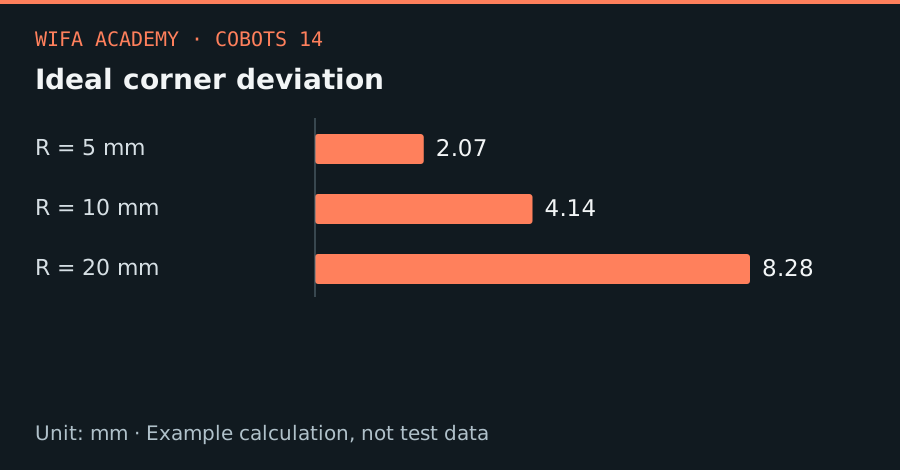
Read the diagram as a data table
| Condition or component | mm |
|---|---|
| R = 5 mm | 2.07 |
| R = 10 mm | 4.14 |
| R = 20 mm | 8.28 |
The calculation
e_corner = R × (√2 − 1)
For an ideal circular fillet replacing a 90° corner, R is radius and e_corner is the corner-to-arc distance along the angle bisector.
Worked example
A 10 mm circular fillet misses the original corner by 4.14 mm. A 20 mm fillet misses it by 8.28 mm. These values illustrate geometric rounding; a controller’s blend-radius parameter may use a different construction.
Try it step by step
- Identify points that must be reached exactly, such as gripping or inspection poses, and keep them separate from transit waypoints.
- Sketch a candidate rounded path and measure the full tool clearance, not merely the centerline clearance.
- Simulate the documented controller blend behavior with the real tool and part model, including adjacent blends.
- Retest at reduced speed under the approved setup and compare the executed path with the offline prediction.
How to check the result
Retain sufficient verified clearance throughout the executed swept volume; a faster cycle is not accepted if it cuts into the fixture envelope.
Common mistake to avoid
Do not equate this ideal fillet equation with a manufacturer’s blending algorithm or use it to establish a safety boundary.
Reference reading
Primary references for the underlying models, APIs or application context. The worked numbers and plots above are educational calculations, not results reported by these sources.