What you need
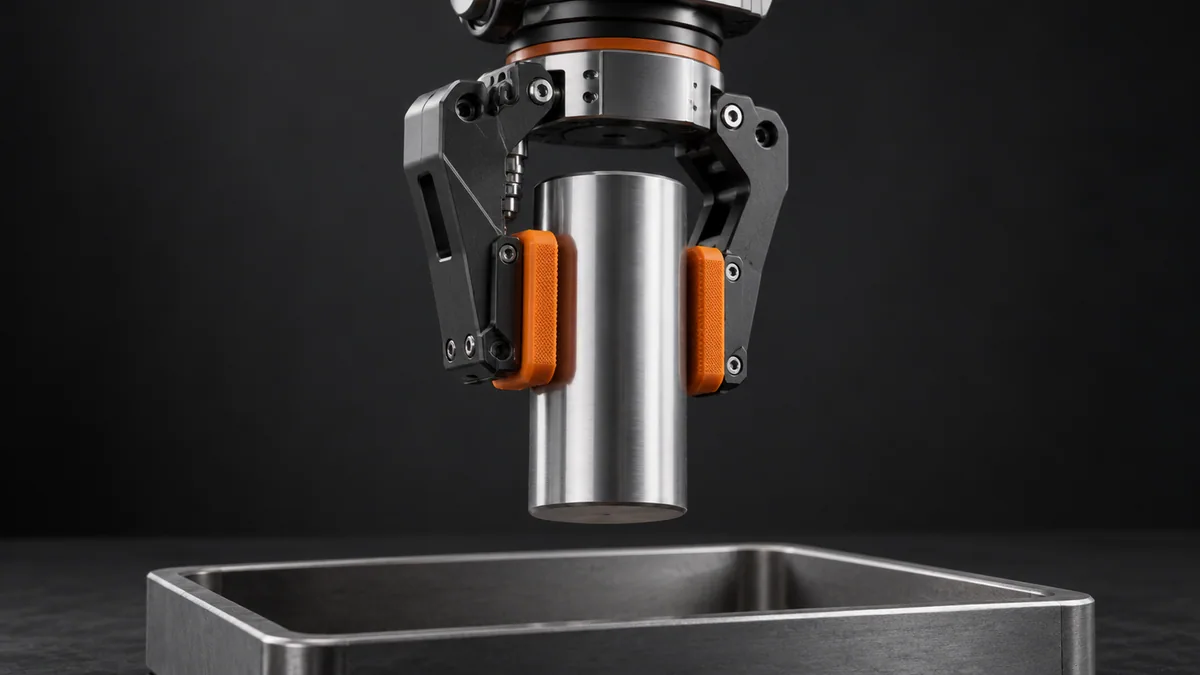
Use representative parts, jaw material samples, a scale and gripper force documentation. Keep drop tests inside a contained fixture.
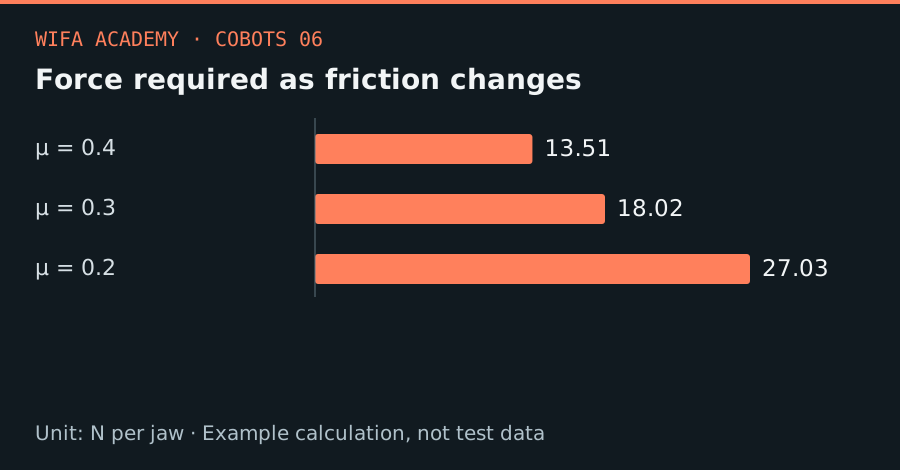
Read the diagram as a data table
| Condition or component | N per jaw |
|---|---|
| μ = 0.4 | 13.51 |
| μ = 0.3 | 18.02 |
| μ = 0.2 | 27.03 |
The calculation
N_per_jaw ≥ S × m × (g + a) / (2 × μ)
N is force per jaw in N; S is an example design factor, m is kg, a is upward acceleration in m/s², and μ is friction coefficient.
Worked example
For m = 0.5 kg, a = 1 m/s², μ = 0.4 and an illustrative factor S = 2, the required force is 13.51 N per jaw. If μ falls to 0.2, the requirement doubles to 27.03 N per jaw.
Try it step by step
- Check whether the supplier quotes force per finger or the sum of both fingers; inconsistent definitions cause a factor-of-two error.
- Estimate friction using the actual jaw and part surface, including expected contamination, rather than a dry-material table alone.
- Calculate the demanding acceleration case and check finger length, bending load, part crushing and actuator duty cycle.
- Validate retention with a contained test at progressively demanding conditions; never test with people below a suspended part.
How to check the result
Record both successful retention and part damage. A larger gripping force is not an improvement if it deforms the component.
Common mistake to avoid
The example factor is not a universal safety requirement. Friction varies, and a gripper must also handle loss of power or pressure appropriately.
Reference reading
Primary references for the underlying models, APIs or application context. The worked numbers and plots above are educational calculations, not results reported by these sources.