What you need
Use controller timestamps or a recorded simulator trace. Label camera, motion, grip and fixture events consistently.
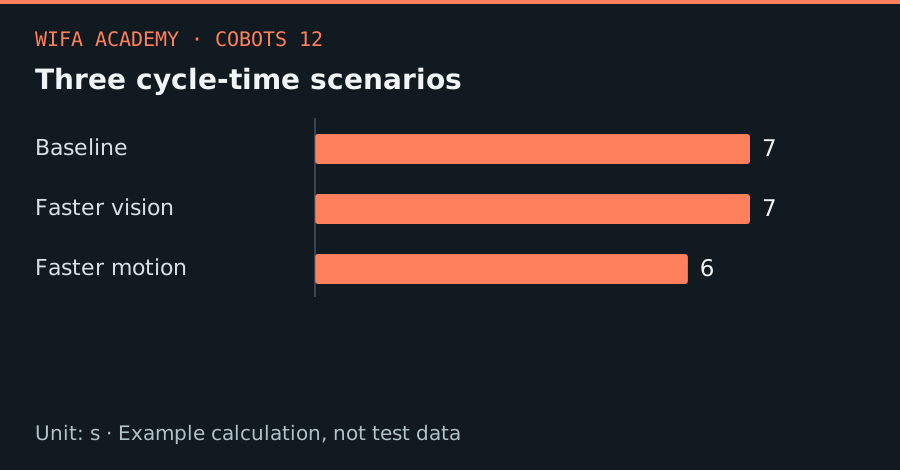
Read the diagram as a data table
| Condition or component | s |
|---|---|
| Baseline | 7 |
| Faster vision | 7 |
| Faster motion | 6 |
The calculation
t_cycle = t_fixed + max(t_motion, t_vision)
This model assumes the two branches start together and both must finish before the fixed remaining work. Times are seconds.
Worked example
With 2 s of fixed work, a 5 s motion branch and 3 s of vision, cycle time is 7 s. Improving vision to 1 s changes nothing. Reducing motion to 4 s produces a 6 s cycle, provided the overlap remains valid.
Try it step by step
- Log event boundaries for multiple complete cycles, including the time spent waiting on external equipment.
- Draw which operations truly overlap and identify the point where the controller waits for both results.
- Change one parameter in simulation and measure the new complete cycle, not just the changed instruction.
- Check that the change preserves inspection quality, payload limits and all validated safety behavior before testing hardware.
How to check the result
A successful optimization improves good parts per hour under the same conditions, without increasing faults or reducing inspection coverage.
Common mistake to avoid
Camera exposure may require the robot to settle. Treating exposure as parallel to motion can produce blurred images and an unrealistic time budget.
Reference reading
Primary references for the underlying models, APIs or application context. The worked numbers and plots above are educational calculations, not results reported by these sources.