What you need
Use a diagram or table and an offline simulator for states such as idle, ready, moving, checking and fault.
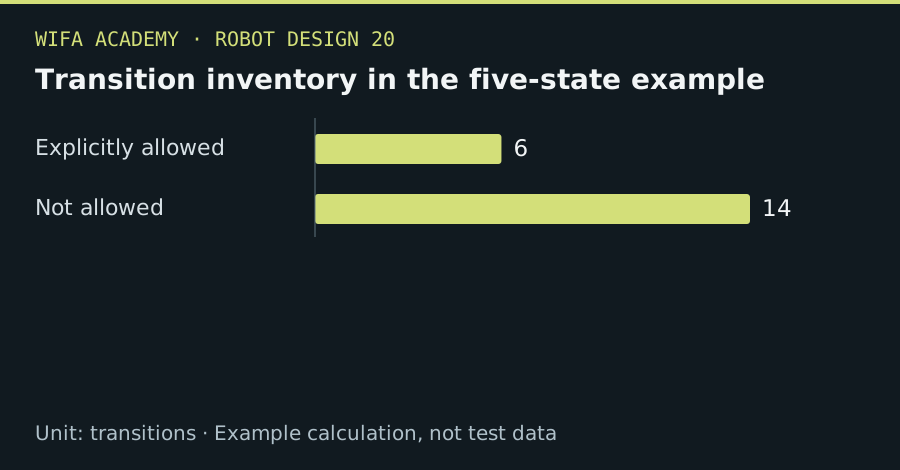
Read the diagram as a data table
| Condition or component | transitions |
|---|---|
| Explicitly allowed | 6 |
| Not allowed | 14 |
The calculation
transition_allowed = valid_state_pair AND guard_conditions
This Boolean expression is an application rule. Guard conditions are process checks and are not automatically safety-rated interlocks.
Worked example
For five states, a fully connected directed graph without self-transitions would have 5×4=20 possible transitions. If the process requires only six, explicitly allowing those six prevents fourteen unintended paths from becoming implicit behavior.
Try it step by step
- List states with a single clear meaning and specify which outputs are allowed in each one.
- Define each transition’s trigger, required conditions and entry or exit actions.
- Add bounded timeouts and a fault state with deliberate recovery rules; never make safety reset an automatic transition.
- Replay normal cycles plus missing sensors, duplicate commands and restarts, and log every state change.
How to check the result
Every event in every state should have a documented outcome: transition, safe rejection or recorded fault, rather than undefined behavior.
Common mistake to avoid
A software state machine organizes control but does not replace a validated safety architecture or protect against every hardware fault.
Reference reading
Primary references for the underlying models, APIs or application context. The worked numbers and plots above are educational calculations, not results reported by these sources.