What you need
Use a purely numerical mass-and-speed example. Do not perform collision tests against people or improvise body-force measurements.
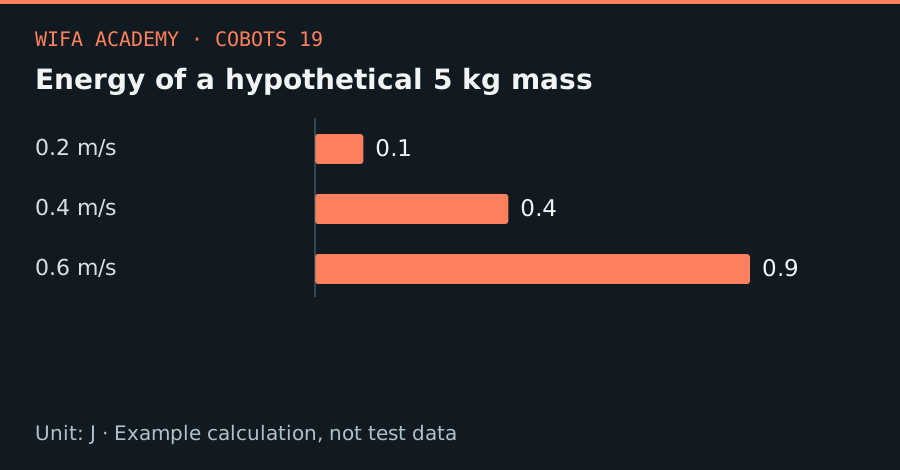
Read the diagram as a data table
| Condition or component | J |
|---|---|
| 0.2 m/s | 0.1 |
| 0.4 m/s | 0.4 |
| 0.6 m/s | 0.9 |
The calculation
E = ½ × m × v²
E is kinetic energy in joules, m is a simplified translating mass in kg, and v is m/s. Robot effective mass depends on configuration.
Worked example
A hypothetical 5 kg translating mass carries 0.10 J at 0.2 m/s, 0.40 J at 0.4 m/s and 0.90 J at 0.6 m/s. Tripling speed multiplies energy by nine, even though mass stays unchanged.
Try it step by step
- Calculate the speed-squared relationship for an abstract mass first, keeping units explicit in the worksheet.
- List what the model leaves out: robot rotational inertia, configuration-dependent effective mass, contact stiffness and geometry.
- Distinguish free transient contact from trapping or crushing situations; low energy does not eliminate sustained-force hazards.
- Use the applicable application risk-assessment and validation process before claiming any collaborative operating condition.
How to check the result
Your conclusion should explain the trend and its limits without labeling any of the example energy values as safe or unsafe thresholds.
Common mistake to avoid
Substituting the robot’s total mass into this equation is not a valid effective-mass model. Sharp tooling, hot parts and pinch points add different hazards.
Reference reading
Primary references for the underlying models, APIs or application context. The worked numbers and plots above are educational calculations, not results reported by these sources.