
ROBOTICS RESEARCH / R002
Same place. New season.
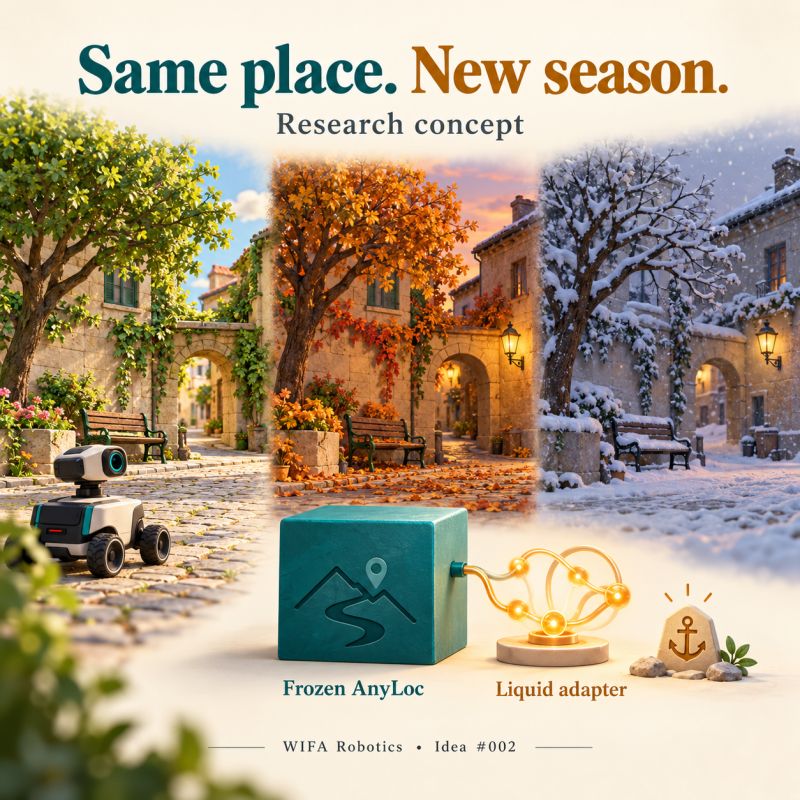
A robot should recognize its favorite corner even when autumn gives it a makeover. 🍂
WIFA Robotics idea #002: could a small liquid temporal adapter help frozen AnyLoc descriptors follow gradual lighting and seasonal changes?
AnyLoc combines pretrained visual features with unsupervised aggregation for place recognition without VPR-specific fine-tuning. The liquid-network flight study learns continuous-time navigation policies from offline demonstrations and tests them under distribution shifts. Connecting these mechanisms is a proposed experiment, not a result from either paper.
I'd stream ordered multi-season traversals, keeping the feature backbone frozen. Compare a liquid adapter with frozen AnyLoc, a GRU adapter, and periodic fine-tuning under matched data and compute budgets. Track Recall@1, adaptation cost, recovery after abrupt changes, and retention on earlier seasons. Keep held-out traversals separate from adaptation data.
The catch: an incorrect match can become an incorrect training signal. Trusted anchors and confidence filtering would be essential, and evolving hidden states alone do not establish safe online weight updates.
Credit to the AnyLoc team, including Nikhil Varma Keetha and Sourav Garg, and the liquid-navigation team, including Makram Chahine and Daniela Rus. Their papers inspired this question.
AnyLoc: Towards Universal Visual Place Recognition
https://lnkd.in/ePfQFg2P
Robust flight navigation out of distribution with liquid neural networks
https://lnkd.in/ewng6ShK
Which anchor signal would you trust before updating a place-retrieval adapter?
#WIFARoboticsIdeas #VisualPlaceRecognition #LiquidNeuralNetworks #Robotics